

What players say
Puck Path Puzzle Challenge works because its difficulty comes from understanding surfaces and obstacles, not from demanding fast reactions. The dotted trajectory preview gives you enough information to plan, while the post-shot feedback teaches you why an attempt failed. The gradual unlock structure and one-handed controls suit casual mobile play. The main limitation is that the input does not describe audio, story, or multiplayer, so the experience appears to rest entirely on puzzle solving.
About this game
Reading the Shot Before You Release
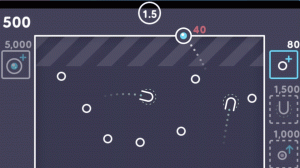
Every level in Puck Path Puzzle Challenge begins with the same simple action: drag backward from the puck to set direction and force, then let go. A dotted line shows the projected path before you commit, so the real work happens in your head rather than your reflexes. You are judging angles, estimating how far the puck will travel, and deciding whether a direct line or a banked route is more reliable. Because the preview only shows the initial trajectory, you also have to think about what happens after the first contact.
Why Surfaces Change Everything
Obstacles are only half the puzzle. The other half is the floor itself. Some surfaces slow the puck quickly, forcing you to use more force or approach from a different angle. Others let it glide, which makes stopping precisely inside the hole much harder. A path that works on one material can fail completely on another, so each stage asks you to re-learn how the puck behaves. This is what separates Puck Path Puzzle Challenge from a straightforward aim-and-shoot game: the environment is an active part of the solution.
Feedback That Teaches the Next Attempt
After each shot, the game shows where the puck traveled and how it interacted with the course. That feedback is not decorative. It tells you whether you misjudged the force, clipped an obstacle, or underestimated how much a surface would slow the puck down. Controls are built for one-handed mobile play, which keeps the focus on planning rather than finger gymnastics. The result is a loop where a failed attempt still gives you something useful to carry into the next one.
Gradual Difficulty and Unlockable Stages
New stages appear as you solve existing ones, and later puzzles tend to demand more creative routes rather than simply longer shots. The difficulty curve introduces new arrangements and surface combinations without dumping everything on you at once. A progress system tracks completed puzzles, so you can see how far you have come. Each solved level closes with a small but real sense of accomplishment, which is the main reason to keep going.
Compatibility
FAQ
Player Comments
Sign in to comment
You must be logged in before posting a review or rating.
No comments yet. Be the first to comment!





Editorial Notes