
What players say
Draw to Rescue succeeds by making the act of drawing feel purposeful. Each level asks you to read a hazardous situation and respond with a line, which keeps the focus on problem-solving rather than reflexes. The progressive difficulty and limited resources add tension without becoming punishing. It is best suited for players who enjoy physics puzzles and creative experimentation. The main limitation is that the core loop may feel repetitive after many levels, but short sessions help mitigate that.
About this game
Sketching Solutions Under Pressure
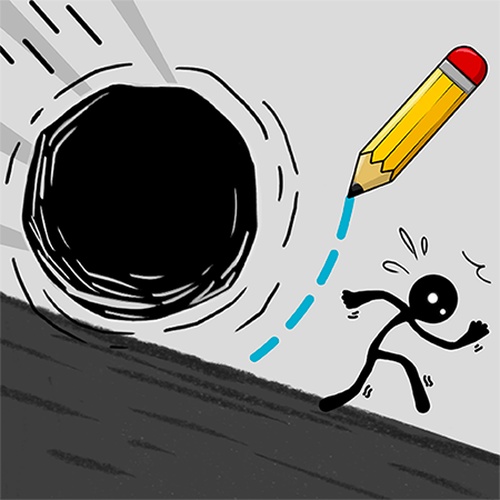
In Draw to Rescue, your finger or mouse becomes a tool for survival. Each level presents a hazardous scenario—falling debris, approaching threats—and you must draw barriers, ramps, or bridges to keep characters safe. The drawing itself is the core interaction: click, drag, release. What you sketch directly determines whether the character escapes harm. The game rewards spatial reasoning and quick assessment of angles and timing.
Levels That Build on Simple Rules
Early stages introduce the basic idea: block a falling object with a horizontal line. Later puzzles layer in moving hazards, narrow safe zones, and limited ink, forcing you to plan before you draw. Because the physics are consistent, each failure teaches you something about trajectory or placement. The difficulty curve stays gentle enough for casual play but demands more precise strokes as you advance.
Designed for Relaxed, Family-Friendly Play
Bright colors and cheerful sound effects set a light tone. There is no graphic violence—just characters in need of a clever line. The game encourages experimentation; if a drawing fails, you simply try another shape. Sessions are short and self-contained, making it easy to pick up for a few minutes. The lack of complex controls means younger players or those new to puzzle games can join without frustration.
Compatibility
FAQ
Player Comments
Sign in to comment
You must be logged in before posting a review or rating.
No comments yet. Be the first to comment!









Editorial Notes